contact us

contact us
We provide best eyelash glue wholesale.
If you would like to leave us a comment please go to contact us

Changing the lamp housing of a UV/LED eyelash curing lamp alters its mechanical structure, heat dissipation, and electrical insulation, which typically requires a compliance reassessment. Under European regulatory frameworks like CE LVD (ZKT-25091522640C) and CE EMC (ZKT-25091522641C), structural alterations during OEM/ODM customization—such as shifting from floor-standing to clamp-mounted or modular head configurations—must undergo evaluation to verify continuous safety and electromagnetic compatibility.
Altering the physical housing of a UV/LED eyelash curing lamp involves changing the external barrier that protects internal electrical components and manages optical emission angles. Key parameters such as gooseneck flexibility, adjustable spot size, and housing material (black or white finishes) directly influence operating temperatures and electrical creepage distances. When a lamp design transitions between floor-standing bases, clamp mounts, or dual-head arrangements, the physical stress on wiring and internal driver placement shifts. These variations require engineering validation to maintain compliance with established low-voltage and electromagnetic standards.
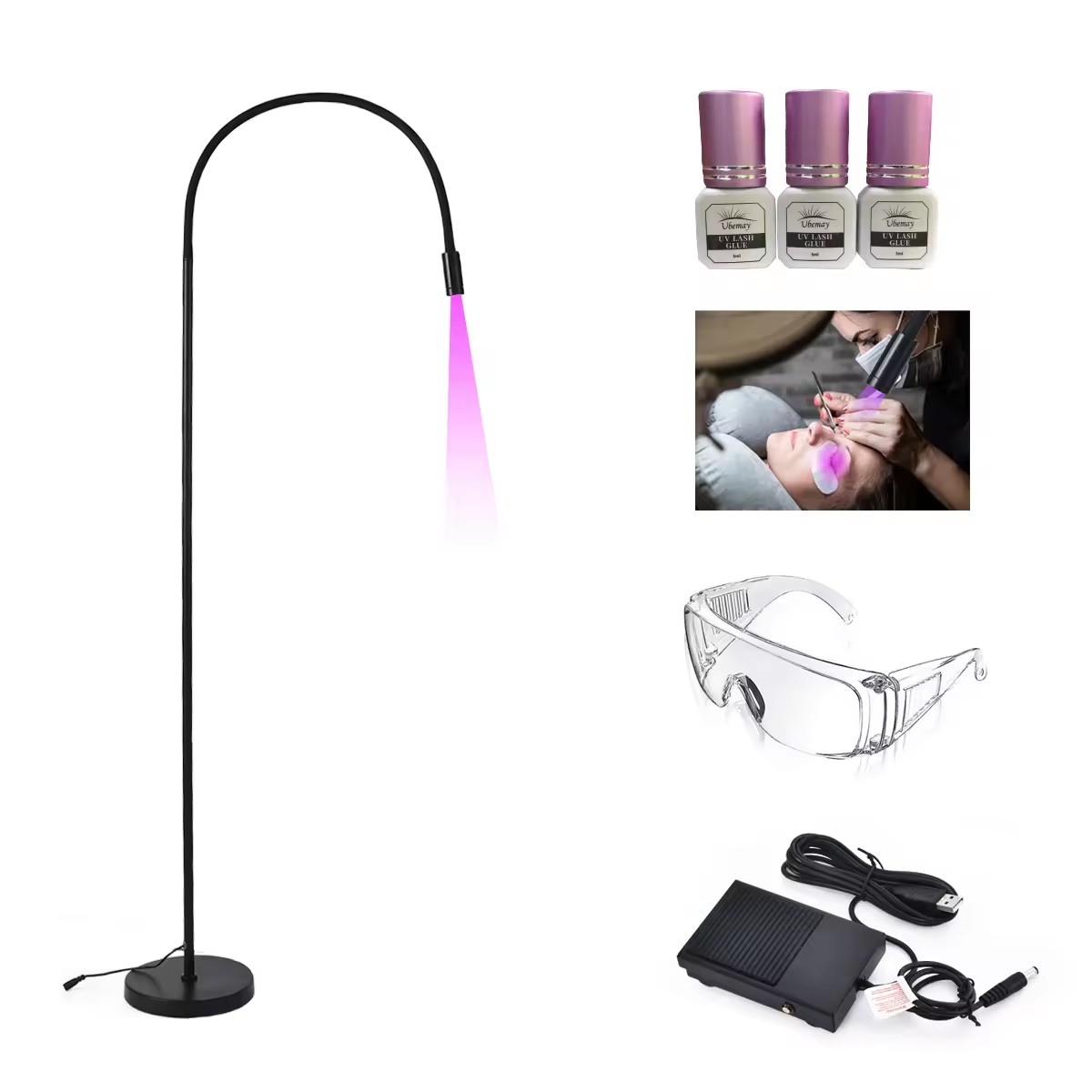
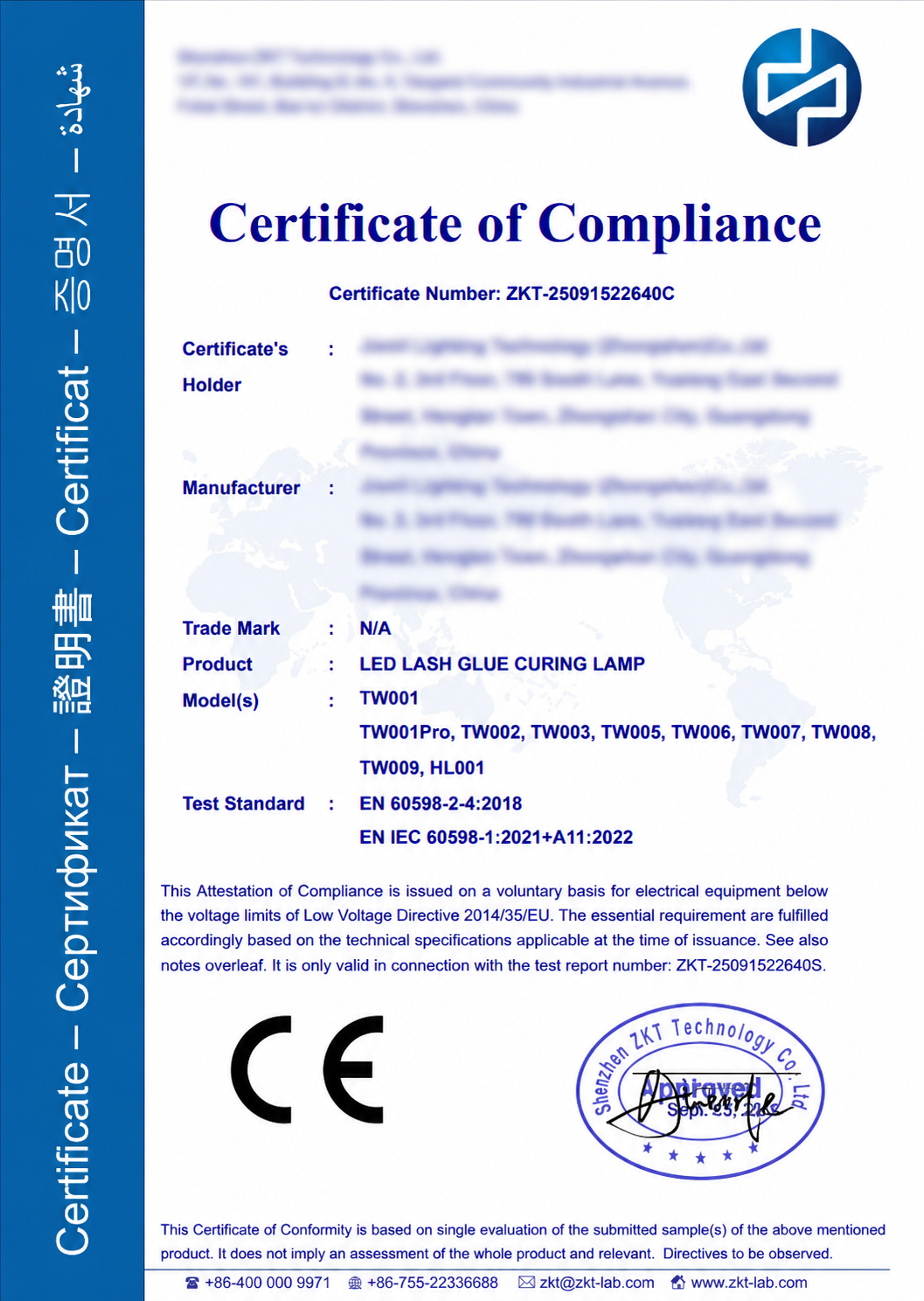
European conformity assessments evaluate low-voltage safety and electromagnetic radiation under technical standards documented in CE (LVD) certificate ZKT-25091522640C and CE (EMC) certificate ZKT-25091522641C. If an OEM/ODM modification alters enclosure shielding, grounding paths, or internal wire routing, a secondary compliance evaluation or technical file update is required to confirm that electromagnetic interference remains within allowed limits and user insulation remains uncompromised.
In international sourcing projects, such as a complete lash product sourcing deployment in Italy involving 3,000 units or private-label eyelash glue and accessory supply contracts in the United States and Brazil, maintaining certified hardware standards avoids supply chain delays. Ensuring that customized lamp heads and structural housings retain compliant electrical isolation pathways allows distributors and salon chains to introduce custom branding while fulfilling regional regulatory demands.
The table below summarizes standard housing configurations available for UV/LED eyelash curing lamps and their corresponding compliance considerations during customization.
| Housing Configuration | Structural Modifications | Compliance Assessment Requirement | Primary Application Scenario |
|---|---|---|---|
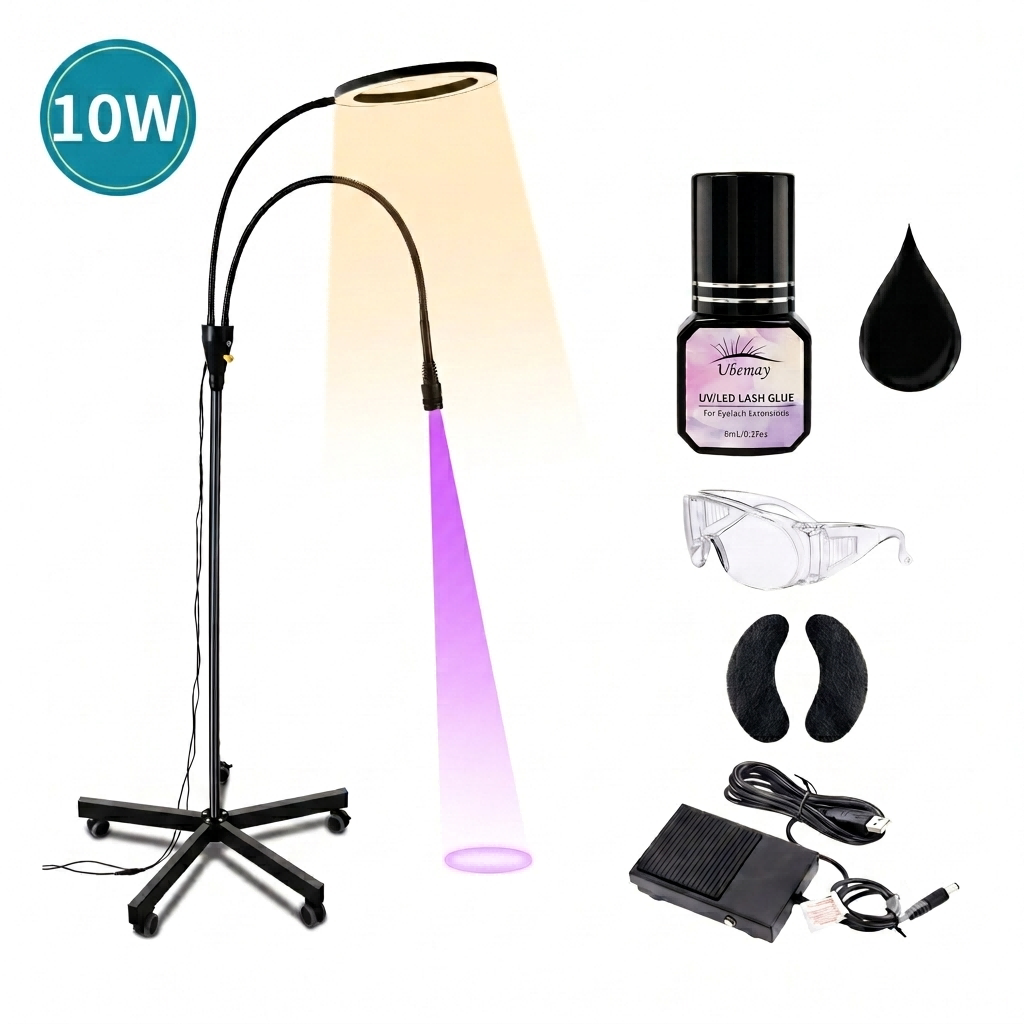
| Floor-Standing Lamp | Heavy weighted base, extended adjustable gooseneck, single/dual head | Requires stability testing and insulation clearance checks under CE LVD | Professional Lash Salons & Eyelash Extension Studios |
| Clamp-Mounted Lamp | Table clamp mechanism, compact flex-arm housing | Requires mechanical stress and vibration inspection; minor risk to EMC | Independent Lash Artists & Mobile Lash Services |
| Modular & Dual-Head Model | Detachable heads, adjustable spot size housing, dual wiring channels | Requires full CE EMC (ZKT-25091522641C) re-verification for harmonic emissions | Lash Training Academies & Beauty Schools |
Q1: Does changing the housing color or cosmetic finish trigger a new compliance assessment?
A: Simple cosmetic changes such as color shifts between standard black and white options using the exact same non-conductive enclosure material do not alter electrical insulation or electromagnetic behavior, so a new compliance assessment is generally not required.
Q2: What housing changes mandate a formal compliance review for UV/LED lash lamps?
A: Altering the housing material from plastic to aluminum, changing internal wire routing, integrating dual lamp heads, or redesigning the power switch placement affects thermal management, grounding, and EMC emissions, necessitating a technical review against CE (LVD) and CE (EMC) standards.
Q3: What are the sample MOQ and production lead times for customized lamp housing orders?
A: Sample orders start at 1 unit with a 7-day lead time. Custom housing orders start at 100 units, with production lead times ranging between 15 and 30 days depending on customization complexity and packaging requirements.
Customizing the housing of a UV/LED eyelash curing lamp provides operational flexibility for salon environments, but structural modifications must be evaluated against low-voltage and electromagnetic compatibility standards. Relying on structured OEM/ODM manufacturing processes ensures that product redesigns—whether clamp-mounted, floor-standing, or modular—undergo systematic incoming inspection, functional testing, finished product testing, and pre-shipment evaluation. Supported business models cover wholesale supply, private label services, and bulk orders shipped via air, sea, express, or DDP channels. For detailed technical solutions or support, please reach out to us via sales@ubemay.com.
Guangzhou Ruiju E-Commerce Co., Ltd. operates the professional eyelash beauty brand UBEMAY, established in 2014. Operating a 5,000 sqm production space with 50 specialized employees, the company exports 80% of its total output across key regional markets in North America, Europe, the Middle East, and Latin America. The organization holds CE (LVD) certificate ZKT-25091522640C and CE (EMC) certificate ZKT-25091522641C for its LED Lash Glue Curing Lamps, along with FDA listings (53-974973-435122 and 53-352156-140573) for lash glues and extensions. UBEMAY delivers comprehensive one-stop supply solutions including private label customization, OEM/ODM development, and complete product line integration for global beauty distributors, salons, and academies.